 HA
HA
Signs of AI Writing: Words, Patterns, and How to Fix Them
Published on: September 8, 2026
Written by: Anthony
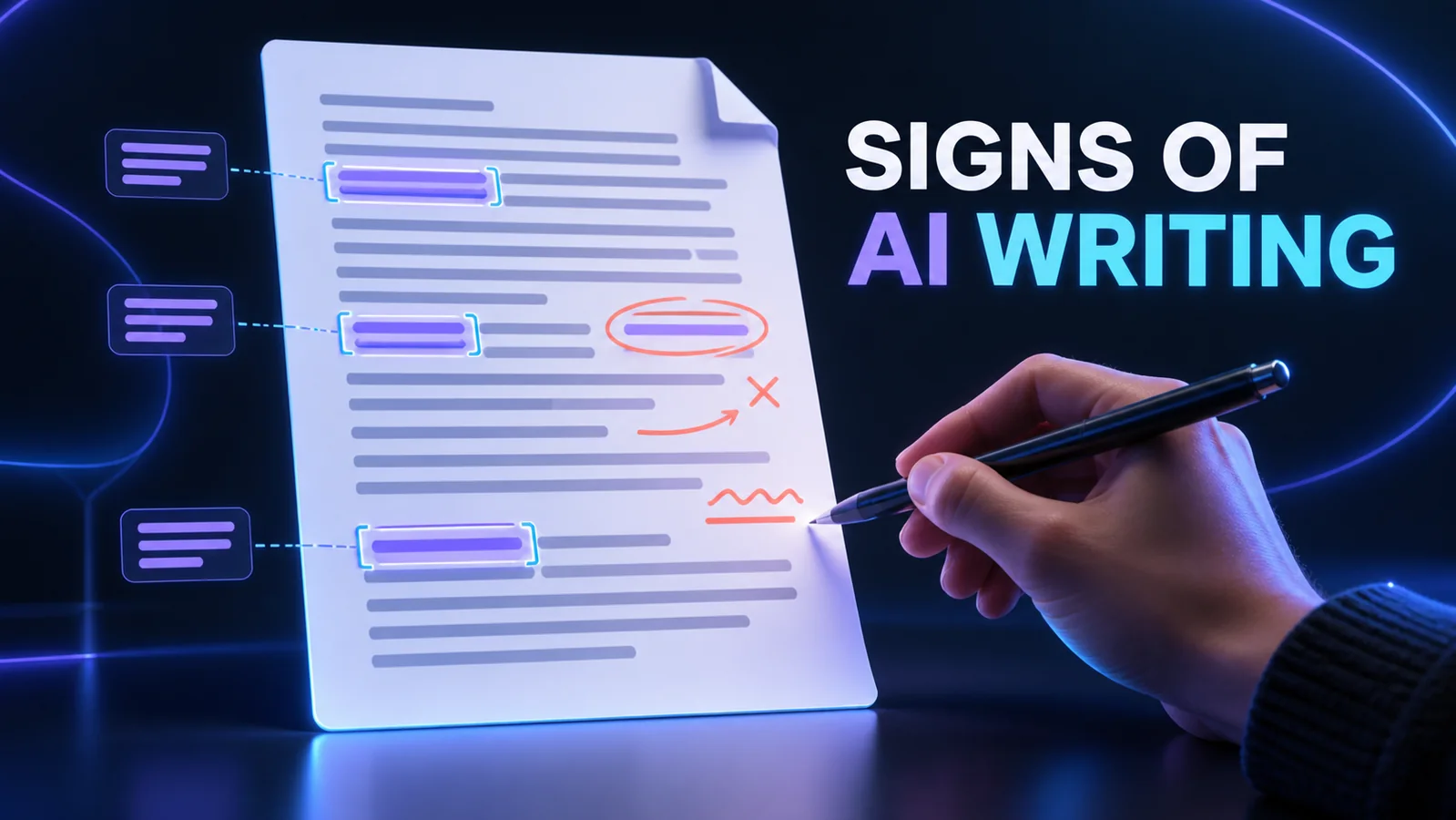
The clearest signs of AI writing are rarely a single word or punctuation mark. They are clusters: stock vocabulary repeated at high density, the same rhetorical frame used again and again, broad claims with few concrete details, overly symmetrical paragraphs, vague attribution, and citations that do not survive a source check.
OpenAI's current model guidance and Wikipedia's evolving field guide now overlap on several of these habits. They also share an important caution: style clues are useful for reviewing a draft, but they do not prove who or what wrote it.
Source note: OpenAI did not publish an AI-detection blacklist. Its GPT-6 Astra model guidance gives developers a prompt for reducing jargon and stock phrases. This article uses that official guidance as an editing aid, not a test of authorship.
Table of contents
What Counts as a Sign of AI Writing?
A sign is a reason to inspect a passage more closely. It is not a verdict. Large language models predict likely continuations from patterns in large bodies of text, so their default output often moves toward broadly applicable wording. That can make a draft smooth and coherent while removing the details that make it specific to one writer, source, situation, or audience.
Wikipedia's Signs of AI writing field guide makes the same distinction. It describes recurring patterns, warns that some are specific to Wikipedia, and says the list is descriptive rather than prescriptive. In other words, the goal is not to ban normal English. The goal is to notice when several generic habits pile up in the same passage.
Use clusters, not gotchas
One use of pivotal is ordinary. Three stock phrases, two contrast formulas, uniform paragraph lengths, and a vague source claim in 150 words form a more meaningful pattern.
OpenAI's Current Stock-Word Guidance
As of September 2026, OpenAI's guidance for GPT-6 Astra includes a sample instruction for reducing jargon and formulaic language. It specifically flags terms and frames such as:
- delve
- foster
- leverage
- importantly
- genuinely
- it's worth noting
- Bottom Line
- Question? Answer.
The same guidance tells developers to avoid canned conclusions, unnecessary contrast framing, invented compound labels, vague qualifiers, and transitions that announce the structure instead of advancing the idea. This matters because AI flavor often comes from the combination of word choice and sentence design, not from vocabulary alone.
The list is also model- and time-specific. Wikipedia notes that the frequency of delve changed substantially after its early ChatGPT peak. Research on millions of biomedical abstracts found abrupt increases in certain style words after broad LLM adoption, while later work found that whole semantic groups can shift together. A static blacklist will therefore age quickly. Density, context, and repetition are more useful than a word counter.
Seven Common Signs of AI Writing
1. A high density of stock vocabulary
Words such as pivotal, robust, tapestry, underscore, and the abstract use of landscape appear in human writing too. The warning sign is concentration. If several arrive in a short section, ask whether each one names something precise.
Replace the label with the thing it is hiding. A "robust strategy" might mean a plan that still works when traffic doubles. A "pivotal update" might mean the update cut checkout time from four steps to two. The specific version is easier to trust and harder to swap into an unrelated article.
2. Importance is asserted instead of demonstrated
AI drafts often tell readers that a subject is significant, enduring, transformative, or part of a broader trend without showing the event, number, decision, or consequence that supports the claim. This produces impressive-sounding prose with little information.
Delete the claim of importance and add evidence. Name what changed, who was affected, when it happened, and why the reader should care. If that information is unavailable, a smaller claim is more honest.
3. The same rhetorical templates keep returning
Common patterns include a miniature question followed by an answer, a repeated "not X but Y" contrast, and groups of three used whether or not the third item adds value. These devices are legitimate. They start to feel generated when they become the default shape of every section.
Read only the first and last sentence of each paragraph. If they repeatedly perform the same setup and resolution, combine some paragraphs, state some claims directly, and keep a rhetorical flourish only where it earns attention.
4. The structure is cleaner than the thinking
Uniform paragraph lengths, identical subhead patterns, a list under every heading, and a summary after every section can make a draft look organized while concealing shallow analysis. Wikipedia highlights overused boldface, inline-header lists, and excessive sectioning as formatting clues in its own editorial context.
Structure should reflect the material. A complex distinction may need two paragraphs. A simple answer may need one sentence. Let the size of the idea determine the size of the container.
5. Attribution and relationships stay vague
Phrases such as "sources suggest," "has been associated with," or "experts have noted" can imply evidence without identifying it. The same problem appears when a draft mentions media coverage but never explains what a source actually reported.
Use a named source and an attributable claim: who said what, where, and in what context. If a relationship is factual, state it directly. If it is uncertain, explain the uncertainty instead of hiding it behind a loose association.
6. Citations look finished but do not verify the claim
A polished reference list can still contain broken links, invented titles, wrong dates, or sources that discuss the topic without supporting the sentence beside them. This is more serious than a style issue because it affects accuracy.
Open every source. Check the author or organization, publication date, exact passage, and whether the source supports the scope of the claim. Remove unverifiable precision rather than replacing one unsupported number with another.
7. The voice does not match the writer or situation
A sudden change from terse messages to flawless corporate prose can be informative when you have a reliable writing history for comparison. So can an unexplained change in spelling conventions, vocabulary, or level of confidence. The useful question is not "Does this sound like AI?" but "Does this sound like this writer, addressing this audience, for this purpose?"
Specific editorial choices are also revealing. A writer should be able to explain why a source was used, why a caveat was added, or why a paragraph was reorganized. That context is often more useful than surface style.
| Possible clue | Weak by itself | More meaningful when combined with | Best review action |
|---|---|---|---|
| Stock word | One natural use | Several generic terms in a short passage | Replace labels with facts or actions |
| Em dash | Normal punctuation | Formulaic contrasts repeated across paragraphs | Keep only where it clarifies the sentence |
| Polished grammar | Expected in edited work | Abrupt mismatch with the writer's established voice | Ask about the drafting and editing process |
| Three-item list | A common rhetorical device | Triplets added throughout without a logical need | Remove the weakest item |
| Detector score | A probabilistic estimate | Source problems, revision gaps, and multiple style clues | Review evidence; do not treat the score as proof |
Common False Positives
Several popular shortcuts are unreliable on their own:
- Em dashes: Human authors have used them for centuries, and model behavior changes. Wikipedia's current guide says this clue works best only with other indicators.
- Curly quotation marks: Word processors, macOS, iOS, and publishing systems can insert smart quotes automatically.
- Perfect spelling: A human can use an editor, a grammar checker, or careful proofreading.
- A colon in the title: It is a normal editorial convention, not an authorship test.
- Formal or non-native English: Technical genres, accessibility needs, education, and second-language writing can all create patterns that detectors misread.
These false positives matter because an accusation can carry real consequences. Review the text and its evidence. Do not diagnose a person from a punctuation mark.
Before-and-After Rewrite Examples
The goal is not to make writing messy. It is to replace generic signals with meaning.
Example 1: Replace abstract importance with a result
This pivotal platform leverages robust automation to transform the customer-service landscape.
The platform routes routine refund requests automatically, so agents can spend more time on cases that need judgment.
Example 2: Remove a canned contrast
Good onboarding is not just about teaching features. It is about building confidence, trust, and lasting success.
Good onboarding helps a new user complete one useful task without asking for help.
Example 3: Make attribution verifiable
Experts widely agree that AI-assisted writing is becoming increasingly common across academia.
A 2025 Science Advances study found abrupt vocabulary changes across more than 15 million biomedical abstracts and estimated a lower bound for LLM-assisted processing in its 2024 corpus.
A Five-Pass Editing Audit
Run these passes separately. Trying to fix facts, structure, voice, and punctuation at the same time makes it easy to polish a sentence that should have been deleted.
- Verify claims. Open every citation and check names, dates, numbers, quotations, and the scope of each source.
- Test the structure. Give each section one job. Remove automatic summaries, repeated conclusions, and lists that do not help scanning.
- Search for phrase clusters. Look for repeated stock terms, contrast formulas, transition words, and three-part constructions. Edit patterns rather than banning words.
- Add missing specifics. Replace broad praise with a mechanism, example, constraint, observation, or measurable result that belongs to this topic.
- Read for voice. Read the passage aloud. Shorten lines that sound staged, vary cadence where the meaning calls for it, and confirm that the tone suits the audience.
If you want a first editing pass before doing the source review yourself, use the free AI humanizer to compare the original and revised versions. You can also follow the longer workflow in our guide to humanizing AI content.
What AI Detectors Can and Cannot Tell You
AI detectors estimate whether a passage resembles examples in their training data. They can help prioritize a review, but they can produce false positives and false negatives. Performance can change with the model, genre, language, text length, and even small edits.
Wikipedia advises editors not to rely solely on detector scores, and research comparing detector and human judgments has also found meaningful error rates. For high-stakes decisions, combine a score with source verification, revision history, assignment context, and a conversation with the writer. Our guide to how AI checkers work explains the main detection approaches and their limits.
Revise the Pattern, Then Review the Meaning
Natural writing does not come from swapping six suspicious words for six approved synonyms. It comes from making the draft more specific, sourced, purposeful, and consistent with the writer's real voice.
Humanize Your TextFrequently Asked Questions
What are the most common signs of AI writing?
The most useful signs are clusters: dense stock vocabulary, repeated rhetorical frames, generic claims of importance, highly symmetrical structure, vague attribution, unsupported citations, and a voice that does not match the writer's usual work.
Is an em dash a sign of AI writing?
No. Human writers use em dashes, and current models do not all use them at the same rate. Repetitive or formulaic em-dash use may support other clues, but one punctuation mark is not evidence by itself.
What words make writing sound AI-generated?
Words such as delve, leverage, pivotal, robust, tapestry, and underscore can sound machine-like when they appear repeatedly or replace specific language. None proves AI use on its own.
Can an AI detector prove that text was generated by AI?
No. Detector results are estimates and can produce false positives or miss edited AI text. Use them as one input alongside source checking, revision history, writing context, and human review.